AI Marketing
Beyond SEO: Understanding AEO and GEO in the Age of AI
SEO vs AEO vs GEO explained: how search, answer engine and generative engine optimisation differ, their strengths and challenges, and why to use all three.
By Cheska Narciso · · Updated · 2 min read
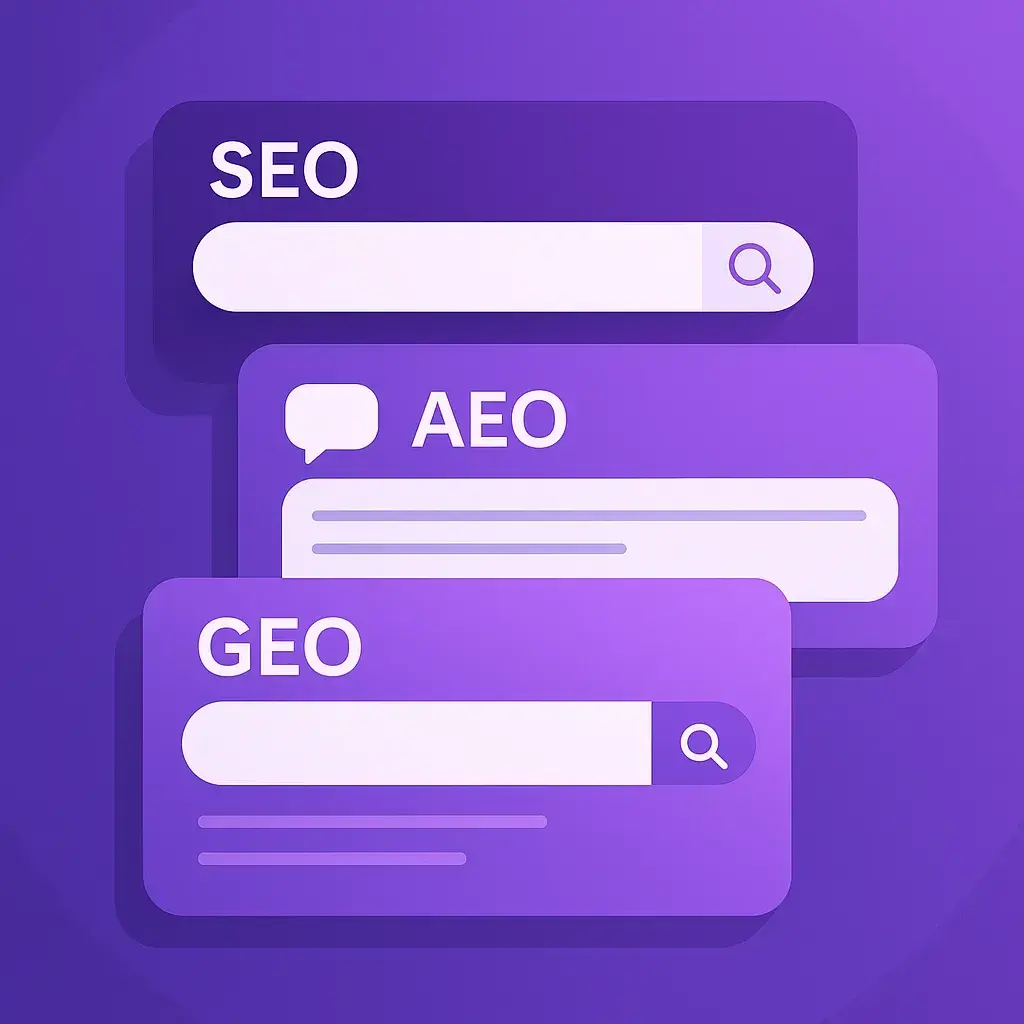
The way people discover content online is changing faster than ever. For years, Search Engine Optimisation (SEO) was the foundation of digital visibility. But today, marketers are navigating two additional frontiers: Answer Engine Optimisation (AEO) and Generative Engine Optimisation (GEO).
Together, these three disciplines shape how brands get found, from traditional search engines to AI-driven platforms. Here’s what you need to know to future-proof your strategy.
SEO: The Foundation of Online Visibility
Definition: Search Engine Optimisation (SEO) is the classic approach to ranking pages on Google through keywords, backlinks, and technical optimisation.
Focus: Ranking pages via high-intent keywords, authoritative backlinks, and technical fixes.
Strengths: A proven, steady driver of organic traffic; builds long-term authority.
Challenges: Competitive, slow to show results, and vulnerable to algorithm updates.
SEO is your baseline. It’s what underpins all other visibility efforts.
AEO: Winning the Zero-Click Answer
Definition: Answer Engine Optimisation (AEO) ensures your content surfaces in Google snippets, “People Also Ask” results, and voice search responses.
Focus: Providing concise, structured answers to user queries.
Strengths: Instant visibility, strong performance on mobile and voice search, higher CTR when clicks happen.
Challenges: Users often get answers without visiting your site, and featured snippet positions change frequently.
AEO gives your brand instant authority and builds trust at the point of search.
GEO: Preparing for the AI-Driven Future
Definition: Generative Engine Optimisation (GEO) is about ensuring your content is cited or summarised by AI-driven search engines like ChatGPT, Perplexity, and Google Gemini.
Focus: Publishing clear, well-structured content that AI can easily summarise.
Strengths: Early-mover advantage, positions brands as trusted knowledge sources, reaches audiences across multiple AI platforms.
Challenges: Harder to measure direct impact, evolving standards, requires a multi-platform presence.
GEO is your future play, positioning your brand in AI-driven search experiences.
Why All Three Matter
SEO builds your base. Without it, your content lacks the foundation to compete.
AEO makes you visible in answers. It’s how you capture attention in zero-click searches.
GEO positions you for AI discovery. It ensures your brand is cited as a trusted source in emerging AI-driven search experiences.
The winners in 2025 and beyond will be the brands that adapt to all three, owning visibility across search engines, answer engines, and generative AI platforms.
Key Takeaway for Marketers
Don’t think of SEO, AEO, and GEO as competing strategies. Instead, see them as a stacked approach to visibility:
Use SEO to create a strong foundation.
Layer in AEO to win quick, high-trust exposure.
Invest in GEO to future-proof your content for AI-driven discovery.
The digital landscape is evolving, the brands that evolve with it will stay ahead.
Our Perspective
At UBE Marketing, we help B2B brands build visibility strategies that go beyond the basics. From optimising your website for SEO, to structuring your content for AEO, to preparing your business for the AI-driven GEO era, we ensure your brand is ready to be discovered, wherever your audience is searching.
If you’re ready to strengthen your digital presence across search, answers, and AI, let’s talk.
This blog was inspired by a LinkedIn post by Santosh Singh, SEO Manager and traffic growth strategist.
Frequently asked questions
What is the difference between SEO, AEO and GEO?
SEO focuses on ranking pages in search engines such as Google through keywords, backlinks and technical fixes. AEO focuses on getting concise, structured answers into snippets, People Also Ask results and voice search. GEO focuses on having your content cited or summarised by AI-driven platforms such as ChatGPT, Perplexity and Google Gemini.
Is SEO still relevant with AI search?
Yes. SEO remains the baseline for online visibility and underpins answer engine and generative engine optimisation. It is a proven driver of organic traffic and builds long-term authority. Without that foundation, content lacks the base it needs to compete, even as brands add AEO and GEO to reach answer and AI-driven search experiences.
What are the challenges of answer engine optimisation?
AEO can give a brand instant visibility, particularly on mobile and voice search, but users often get their answer without visiting your website. Featured snippet positions also change frequently, so visibility can be harder to hold than a standard organic ranking. It works best layered on top of a strong SEO foundation.
How do you optimise content for generative AI search engines?
Publish clear, well-structured content that AI platforms can easily summarise, and build presence across multiple platforms. GEO can position your brand as a trusted knowledge source and give early movers an advantage, though its direct impact is harder to measure and the standards are still evolving.
Need a hand?
AI Marketing
Brand refresh and AI-ready websites, plus AI visibility and automation.
How we help →